May 2002 Slide Show...
June 2007 Slide Show...
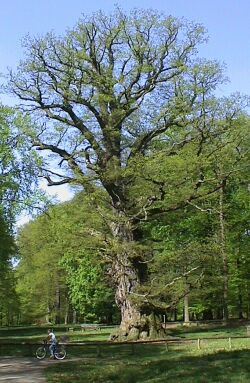
The King of of German Oak Trees
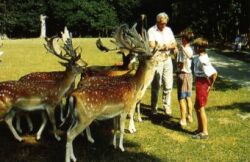
fallow deer
at feeding ground
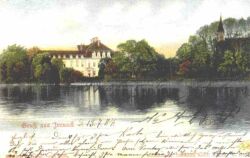
View of the Castle
across the sea in 1904
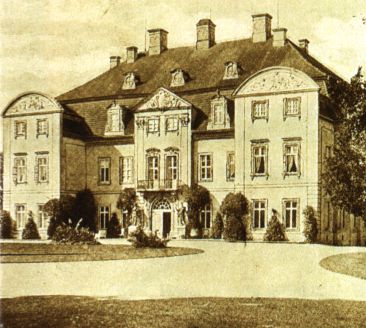
The Castle in 1910
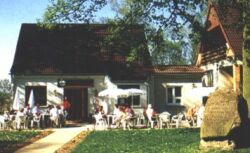
The "Schloßcafe" nearby the Castle serves
light refreshments,
a booklet with a map of walks and picture postcards
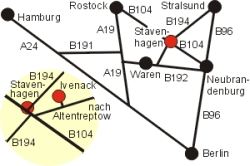
Route: two or three hours by car from Berlin
|
"I want to get as old as this tree
",
that's what I
thought when I saw that oak tree the first time.
Sadly, this is not going be to happen as it
is appr. 1200 years old ... Thus, it is one of the oldest
oak trees in Germany!! Alongside other very old oak trees
(at least 800 years old) it is located near Ivenack,
a little village next to Stavenhagen in
Mecklenburg (West Pomerenia).
"Stavenhagen" -
a town that's known at least to all old
northern Germans as the famous local writer Fritz Reuter
was born here. He knew the old oak trees and immortilized
his impressions in a poem, written in low-german:
"Ick weit einen
Eikbom, de steiht an de See,
De Nurdstorm, de brus't
in sin Knäst,
Stolz reckt hei de
mächtige Kron in de Höh;
So is dat all dusend Johr
west."
However, not just this giant oak tree with a trunk girth of
11 meters, a height of 35.5 meters and 180 solid cube meter of timber is always worth visiting.
The "Eichenallee" - an oak tree avenue of a special kind is
surrounded by a large deer enclosure and therefore a unique
deer park worldwide. The keeping of deer under trees reflect
the conditions under wich the oak trees could grow to their
present height. The former slavic villagers
used the forest as "Hudewald"; the acorns were good fodder
for the pigs. The place name verifies the slavic usage as
"Iva" means "pasture".
If the reader after this reading decides to travel to
Ivenack or to make a little detour to Ivanack on his way
to the baltic sea coast I would like to give some useful
advice.
He should park his car on the outskirts of the village.
Only by strolling he will discover the beautiful
timber-framed houses, the orangery, the church and
the castle. It was built on the foundation walls of a
Cistercian monastery founded here in 1252.
The way to the deer enclosure leads past the impressive
stables of the stud farm founded in 1790.
The famous white horse stallion Herodot lived here. It was
abducted in 1806 and brought back by general field marshal
Blücher after the "Paris Peace" in 1814. An old
chronicler stated that Napoleon rode that stallion on all
his victorious military expeditions. The then count
Albrecht Joachim of Plessen and his sons played a decisive
role in founding the first German racecourse in
(Bad) Doberan. Shortly after his death a world famous
English horseman visited the stud farm on his trip
through Germany. In the "Sporting Magazine" of 1829
he reported amongst other things:
"
Friday,
[August] 22d. [1828] We all mounted our horses as
soon as breakfast was over, and proceeded to Avenack,
the magnificent seat of count Plessen, distant from
Basedow about eighteen English miles. Of this family I
have already spoken, the late Count having died
about six weeks previous to my arrival in Germany,
and which circumstance was a great drawback from the
sport at Dobberan, his sons having eight horses in
training, which of course did not start. The third and
youngest son also is one of the best gentleman jockeys in
Germany; and, by all that I could learn, I should have
found him a formidable opponent in the race for the
Silver Cup.
Of the late Count I must say a word, although I had not
the pleasure to of seeing him previously to his
beeing called to his last home. From all I heard from
him, he was one of the liberal, open-hearted,
old-fashioned sort of country gentlemen, of which all
Europe was once proud, but whom the over-refinement and
hypocritical canting of the present day have endeavored
to supplant by a cantious, stiff-necked, cold-blooded,
game-preserving exquisite, whose appearance is all
but suspicious, and who thinks of little else but
himself. This much respected Nobleman lived on an
advanced age, having kept a pack of fox-hounds for
upwards of fifty years, and - as I shall shew - was one
of the most extensive breeders of horses in Germany.
The name of this Noble family is Maltzahn of whom there
are;three brothers. The elder, the present Count, was not
at home; but the two Barons Maltzahn received us with the
greatest kindness, and evinced much pleasure in shewing
us all the stud. The youngest of the brothers was for
some years the Minister of the Court of Prussia in
England, which situation he relinquished only a few years
since. It is unnecessary then to add that he was able to
converse to us in English.
We where much pleased with the approach to this grand
seat, which was through a noble avenue of oaks; and - the
first I had seen in Germany - a deer park adorned the
domain. Whether it be that we are accustomed to it in
England, but the seat of a Nobleman appears to want this
noble appendage; and when we reflect on the name
bestowed upon it by antiquity, it can scarcely be
purchased at too high a price. The timber in this park is
particularly fine; there is a piece of water, four
miles round; and - as far I could judge by merely
driving though it - a good herd of party-coloured fallow
deer.
To us the grand sight was now to come - of course I mean
the stud. Reader, do not stare; neither imagine I am
writing with a travellers licence, when I state, that in
the two first stables we entered we saw one hundred
horses in condition -;that is to say, with sleek coats
and in body clothes! These were exclusive of race-horses,
hacks, &c. which was dispersed in other stables.
The breeding stud, at the Counts death, consisted of
about ;twenty stallions and one hundred and thirty brood
mares, which, with colts of various ages and foals, made
the sum total rather more than five hundred. The present
Count has selected for himself seven stallions,
fifty-four brood mares with some colts, and all the foals
of this year, making a total of two hundred and fifty;
and the two younger brothers, the Barons Maltzahn possess
the rest.
I think I have stated before, that, in a oration spoken
in a Court of Justice by the renowned Isocrates, he
contented himself with the proof of the nobility of his
client, by tracing his pedigree to the first of his
countrymen who had won a prize in the chariot-race at the
Olympic Games. Horses then were the possessions only of
the rich and great, as indeed they in a great measure are
at present. The wealth of the principle characters in the
Bible also is generally estimated by the amount of their
cattle, and some of them were truly rich in this
description of property.
If Tacitus is to be credited, the Germans have ever been
famous for immense herds of cattle; but I little imagined
that in any one mans possession I should find the stock
as is kept at Avenack. I have already enumerated the stud
of horses, therefore I need not recur to that; but
curiosity led me to ascertain the number of sheep on the
farms occupied by the Count, when I found it amounted to
fifteen thousand! And pray, said I, to Baron Maltzahn,
how many cows do you keep here? Why, replied he, in
consequence of the great number of horses and our large
flock of sheep, we only have thirteen hundred cows!!
"
by Charles James Apperley, better known under his pseudonym
"Nimrod".
|